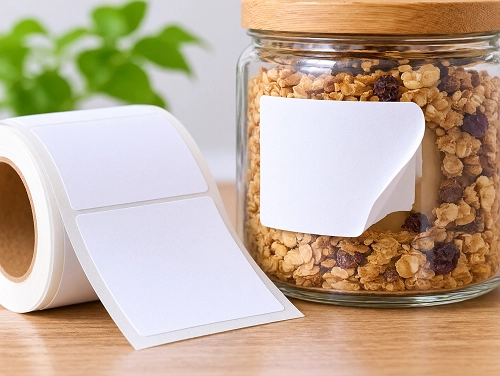
A removable woodfree paper label is a self-adhesive label with a paper face made mainly from chemical pulp and an adhesive designed to release cleanly. It is a good fit for temporary pricing, routing and identification where you need to peel the label off later without leaving residue or tearing the surface.
A removable woodfree paper label has three layers: a bright, uncoated woodfree paper face; a low-tack removable acrylic adhesive; and a glassine or PE-coated release liner. It prints well on laser, inkjet and thermal transfer equipment. It is meant for short-to-medium-term use. It is not meant for permanent marking or for harsh outdoor exposure. Guanhao supplies it as part of its Removable Woodfree Paper Label range, within the wider Woodfree Adhesive product family.
"Woodfree" is a common source of confusion. It does not mean the paper contains no wood fibre. It means the pulp is chemically processed rather than mechanically ground. Mechanical pulp keeps the lignin that makes paper yellow over time. Chemical pulping removes most of it. Under a common industry convention, woodfree grades contain little or no mechanical pulp, and Guanhao describes its removable stock as made without mechanical pulp.
For a label buyer, this has three practical effects:
Most buyers look at the paper, but the adhesive decides whether a label is removable. A removable acrylic adhesive is formulated to develop a lower bond than a permanent one. It also builds up more slowly over time.
| Layer | Typical Material | Role in Removability |
|---|---|---|
| Face stock | Woodfree paper (chemical pulp), 80 gsm standard | Must be strong enough to peel off in one piece rather than tear |
| Adhesive | Removable, low-tack acrylic | Sets the bond level and how fast it builds with time |
| Release liner | Glassine or PE-coated paper | Silicone coating lets the label release cleanly and run through converting and dispensing |
The table below reflects the data published on Guanhao's product page. Custom ranges are available on request through the sales team.
| Parameter | Standard | Customisable Range |
|---|---|---|
| Face material | Woodfree paper (chemical pulp) | Matte or semi-gloss |
| Adhesive | Removable, low-tack acrylic | Adjustable tack levels |
| Paper weight | 80 gsm | 60–120 gsm |
| Total caliper | Approx. 110 µm | 90–160 µm |
| Liner | Glassine / PE-coated | Paper or film liner |
| Application temperature | +5 °C to +40 °C | Cold-apply grades available |
| Service temperature | −20 °C to +70 °C | Extended range on request |
| Printing methods | Laser, inkjet, thermal transfer | Flexo and offset on request |
| Supply format | Roll, A4 or custom sheet | Any width or roll diameter |
Note on ordering: Guanhao's woodfree adhesive category page lists a minimum of 500 kg per SKU for custom rolls and 3,000 sheets for A4 sheet orders, and says smaller trial orders may be accommodated. Confirm the current MOQ for your grade before planning a project.
These terms are often used loosely in quotations and specifications. Agreeing on definitions with your supplier early prevents disputes later.
| Adhesive Type | Behaviour | Typical Use |
|---|---|---|
| Permanent | Strong bond; removal usually tears the face or leaves residue | Product identification, regulatory marking |
| Removable | Holds securely, then peels off cleanly; may not re-stick well after the first removal | Price tags, promotions, temporary routing |
| Repositionable | Designed to be lifted and re-applied several times | Office notes, adjustable signage |
Guanhao's product page describes its removable woodfree label as both residue-free and repeatable. If re-application matters to you, ask for the number of reliable re-applications on your target surface instead of assuming it.
Complaints about removable labels rarely come from one cause. These are the four factors to examine first.
1. Dwell time. Almost every pressure-sensitive adhesive bonds more strongly as it wets out the surface over hours and days. A label that peels cleanly after ten minutes may behave differently after three weeks. Test at the dwell time your product will actually see.
2. Substrate. Smooth glass and metal usually give clean removal. Porous or fibrous surfaces, such as raw corrugated board, can anchor the adhesive and cause fibre tear. Some soft plastics contain plasticisers that can migrate into the adhesive over time. Low-energy plastics such as PE and PP can also behave differently from glass.
3. Environment. Heat, humidity and sunlight speed up adhesive build-up. Paper face stock also loses strength when wet, so removal from damp or condensing surfaces may cause the label to tear rather than peel.
4. Removal technique. Peeling slowly from one edge at a low angle puts less stress on a paper face than pulling quickly. Staff training matters in high-volume retail and warehouse settings.
A short, structured trial costs far less than a relabelling exercise. Industry test methods published by FINAT, the European label association, are the usual reference points for adhesive performance. These include FINAT FTM 1 for 180° peel adhesion and FTM 9 for loop tack. For your own trial, follow this sequence:
| Industry | Typical Use | What to Verify | More Information |
|---|---|---|---|
| Retail and e-commerce | Price tags, promotional stickers | Clean removal from glass and PE bottles | Retail Labels |
| Logistics and warehousing | Carton ID, routing labels | Barcode scan rate; behaviour on corrugated board | Logistics Labels |
| Pharmaceutical | Secondary packaging, batch tracking | Residue-free removal; regulatory rules | Drug Labels |
| Electronics | Component and asset identification | No marks on sensitive surfaces | Electronic Labels |
| Industrial | Production-stage and inspection tags | Durability during the process, easy removal at the end | Industrial Labels |
| Office and education | File tabs, name badges | Repositionability on paper | A4 Flat Sheet Labels |
| Daily chemical and FMCG | Promotional overlabels, bundle labels | Moisture and oil exposure | Daily Chemical Labels |
An honest comparison builds trust, so here is where this label is not the right answer:
According to its About Us page, Zhejiang Guanhao Functional Material Co., Ltd. is a wholly owned subsidiary of Guangdong Guanhao High-tech Co., Ltd. (stock code 600433), owned by the central enterprise China Paper Investment Co., Ltd. The company is based in Xincang Town Industrial Park, Pinghu, Zhejiang, with a registered capital of 218 million yuan. It runs four self-adhesive production lines. Across its Zhejiang and Guangdong bases, annual capacity reaches 1.1 billion square metres. Products are exported to more than 50 countries and regions.
Its quality system covers raw material inspection, silicone coating, adhesive coating, slitting and shipment. Guanhao states that it holds ISO 9001 quality system certification and RoHS environmental testing certification (SGS), and that its production lines are equipped with online detection systems. Buyers with compliance requirements, such as FSC chain of custody or food-contact rules, should request the relevant certificates and test reports directly.
Is a removable woodfree label recyclable?
Paper-based labels are generally easier to handle in paper recycling than plastic films, but liner waste and local recycling rules still apply. Ask your recycler about the label-plus-liner combination.
Can I print it on a desktop printer?
Yes. Guanhao lists laser, inkjet and thermal transfer compatibility. Always test your own printer settings and barcode quality.
Will it leave residue on every surface?
No supplier can honestly promise that for every surface and every dwell time. Residue depends on the substrate, time, temperature and removal method. That is why a trial on your real materials matters.
Can the adhesive strength be adjusted?
Guanhao lists adjustable tack levels as a customisation option. Discuss your target surface and required hold time with the technical team.